
SKU 2164168
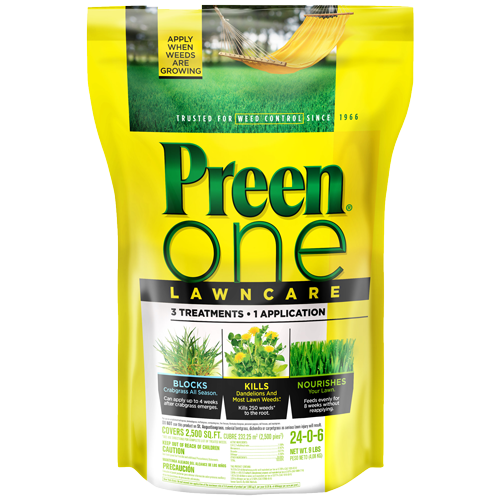
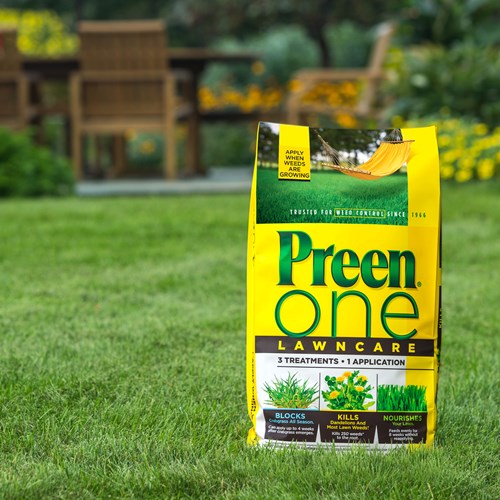
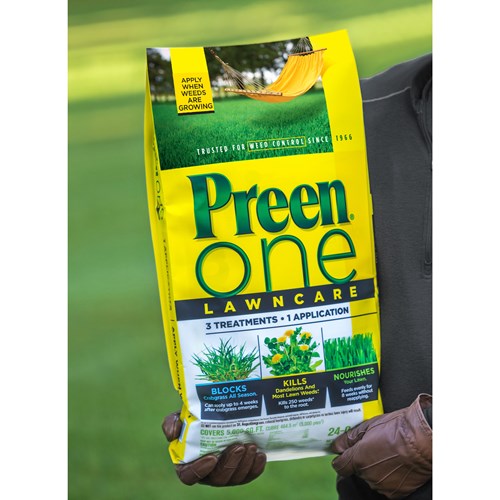
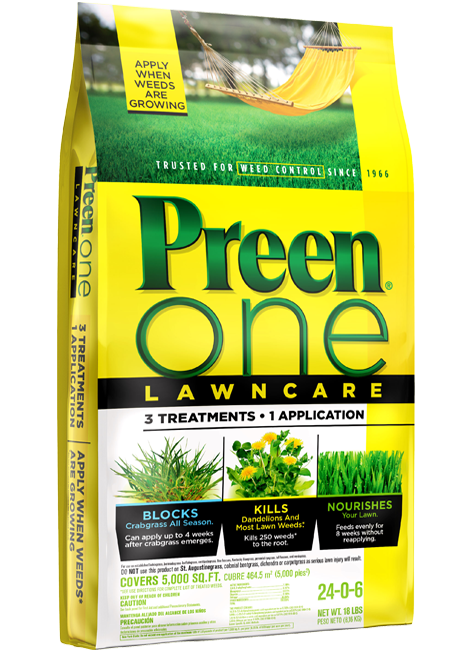
Write a ReviewPreen One Lawncare delivers three essential lawn treatments in one easy application. Kill broadleaf weeds, prevent crabgrass, and feed your lawn - in one time-saving step. For a weed-free, worry-free, one-derful lawn.
Select a Size
BAG
18 lb.
Covers 5000 sq. ft.
BAG
18 lb.
Covers 5000 sq. ft.
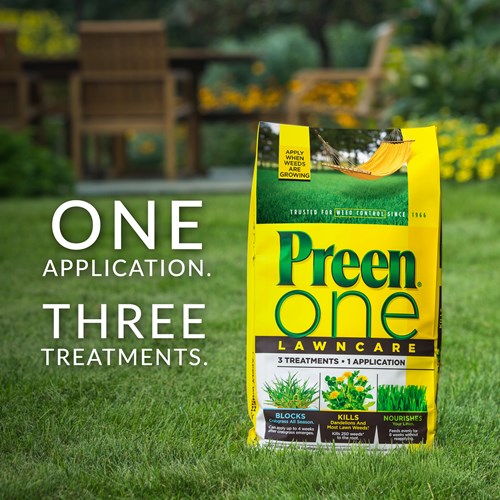
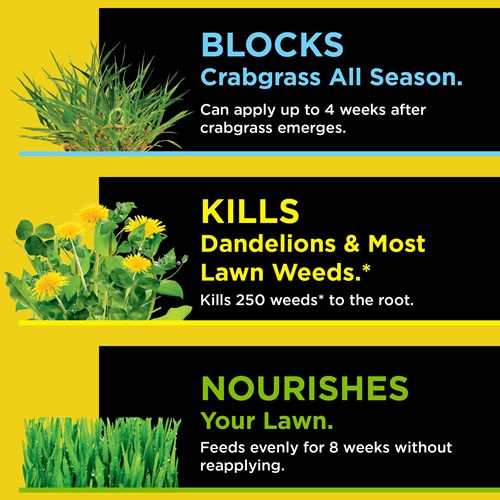
One application, three treatments.
crabgrass all season and can be applied up to 4 weeks after crabgrass emerges.
dandelions and 250 of the toughest weeds to the root.
your lawn by evenly feeding for 8 weeks without the need to reapply the product.
Watch, learn, then try for yourself
This product may be applied to established lawns as a single application or as split applications in the spring, early summer, or fall. For the best results in the spring, apply this product one to two weeks before the expected germination of crabgrass. When the period of germination for crabgrass and other weeds listed on this label extends into early summer, then a second application can be made at six to ten weeks after the initial application.
Apply the product when grass and weeds are actively growing under adequate soil moisture and favorable temperatures (50°F to 80°F). Do not apply under drought conditions.
In the spring, the ideal time to apply Preen One Lawncare is after the forsythia has bloomed or when the first dandelion flowers appear. For full weed control in lawns in southern areas, make a second application in six to eight weeks for best weed and crabgrass control and for full season fertilization. In the fall, apply Preen One Lawncare when the weather cools and both the grass and weeds are actively growing, generally around Labor Day.
For established lawns, apply Preen One Lawncare when broadleaf weeds are actively growing and prior to germination or tilling of annual grasses. It may be applied as a single application or as a split application in spring, summer, or fall.
You can reseed or overseed a lawn treated with Preen One Lawncare 10 weeks after application.
If the lawn has been seeded recently, wait until after the third mowing before using this product.
For optimum weed control in lawns, apply Preen One Lawncare to grass when the lawn is wet from rain, dew, or sprinkling, as this product needs to stick to the leaves of broadleaf weeds. The lawn should not be watered or disturbed for at least 24 hours after application.
For best results, we recommend that you:
Apply this product when the wind is calm. Do not apply this product to desirable plants or shrubs as damage may result. If the product gets onto other plants, immediately brush or wash it off the foliage.
Use a drop or rotary spreader designed to apply granular fertilizers. Uniform coverage is essential for best results. It should take approximately 2 to 4 weeks to see the label-listed broadleaf weeds succumb.
For use on established bahiagrass, bermudagrass, buffalograss, centipedegrass, fine fescues, Kentucky bluegrass, perennial ryegrass, tall fescues, and zoysiagrass.
DO NOT use on St. Augustinegrass, colonial bentgrass, dichondra, or carpetgrass as serious lawn injury will result.
This product is not for use:
Note: Do not use clippings of treated grass as mulch or in compost piles.
Preen Guarantee
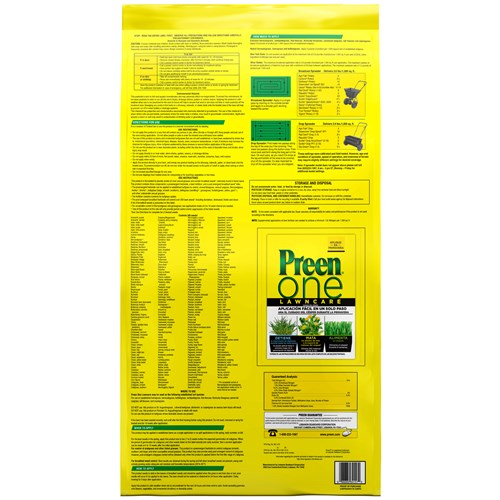
Preen® Guarantee: To the extent consistent with applicable law, Lebanon Seaboard Corporation guarantees you will be satisfied with the performance of Preen® products when used as directed, or your money back. If not satisfied, describe the nature of your problem, and send with proof of purchase to:
Lebanon Seaboard Corporation
1600 East Cumberland St.
Lebanon, Pa 17042
What are the active ingredients in Preen One Lawncare?
1.108% of 2,4-D, 2-ethylhexyl ester
0.167% Mecoprop-p
0.071% Dicamba
0.160% Dithiopyr
What are the other ingredients in Preen One Lawncare?
The carrier agent/particle for the active ingredient which can be corn cob, limestone, etc.
How does this product work?
Preen One Lawncare contains three components to provide control of most annual grasses and certain broadleaf weeds commonly found in home lawns.
The preemergent herbicide can be applied to established turfgrass to control, annual bluegrass, annual ryegrass, Barnyardgrass, barley++, brome++, crabgrass (large, smooth, southern), dallisgrass (seedling)++, goosegrass, foxtails(green, yellow, giant++), and other undesirable annual grasses.
The fertilizer contains nutrients for turfgrass uptake.
The post-emergent broadleaf herbicide will control over 250 lawn weeds* including dandelion, chickweed, thistle, and clover.
Which weeds are controlled by Preen One Lawncare?
See Use Directions for complete list of weeds controlled.
How long does Preen One Lawncare control weeds?
Preen One Lawncare stops crabgrass and most annual grassy weeds all season and can be applied up to 4 weeks after crabgrass emerges. Preen One Lawncare kills dandelions and up to 250 other tough lawn weeds as listed, to the root.
annual bluegrass
annual ryegrass
artichoke thistle
aster
Austrian fieldcress
barnyardgrass
beggarticks
bird vetch
bitter wintercress
bitterweed
black medic
black mustard
blackeyed Susan
blackseed plantain
blessed thistle
bloodflower milkweed
blue lettuce
blue vervain
brassbuttons
Brazil pusley
bristly oxtongue
broadleaf dock
broadleaf plantain
broomweed
buckhorn plantain
bull thistle
bullnettle
burdock
burning nettle
burweed
California burclover
California buttercup
Canada thistle
Carolina geranium
carpetweed
catchweed bedstraw
catnip
catsear
chickweed
chicory
cinquefoil
clover
cockle
cocklebur
common mallow
common mullein
common sowthistle
corn speedwell
creeping beggarweed
creeping jenny
creeping woodsorrel
crimson clover
crowfootgrass
cupid shaving brush
curly dock
daisy fleabane
dandelion
dichondra
dogfennel
dollarweed
English daisy
false dandelion
false sunflower
falseflax
fiddleneck
field bindweed
brome
Florida betony
Florida pusley
frenchweed
galinsoga
goldenrod
goosegrass
green foxtail
ground ivy
groundsel
gumweed
hairy bittercress
hairy fleabane
hairy galinsoga
hare barley
hawkweed
healall
heartleaf drymary
heath aster
hedge bindweed
hedge mustard
hemp
henbit
hoary cress
hoary plantain
hoary vervain
hop clover
horrible thistle
horsenettle
India mock strawberry
jimsonweed
Kikuyu grass
knawel
kochia
lambsquarters
large crabgrass
largeflower pusley
lespedeza
matchweed
milk vetch
morning glory
mouseear chickweed
mouseear hawkweed
mugwort
musk thistle
narrowleaf vetch
orange hawkweed
oriental cocklebur
oxeye daisy
parsley piert
pearlwort
pepperweed
pineappleweed
plains coreopsis
poison ivy
poison oak
pokeweed
prairie sunflower
prickly lettuce
prickly sida
prostrate knotweed
prostrate pigweed
prostrate spurge
prostrate vervain
puncturevine
purslane
ragweed
red clover
red sorrel
redroot pigweed
redstem filaree
rough buttonweed
rough cinquefoil
Russian pigweed
scarlet pimpernel
Scotch thistle
shepherds purse
slender plantain
smallflower galinsoga
smooth chaff-flower
smooth crabgrass
smooth dock
smooth pigweed
smutgrass
sorrel
southern crabgrass
speedwell
spiny amaranth
spiny cocklebur
spiny sowthistle
spotted spurge
stinging nettle
strawberry clover
tansy ragwort
tansymustard
tanweed
tickseed
trailing crownvetch
tumble mustard
tumble pigweed
velvetleaf
Venice mallow
Virginia buttonweed
Virginia creeper
Virginia pepperweed
western clematis
western salsify
white clover
white mustard
wild aster
wild buckwheat
wild carrot
wild four-o'clock
wild garlic
wild marigold
wild mustard
wild onion
wild parsnip
wild radish
wild rape
wild sweet potato
wild vetch
wild violet
wood nettle
woolly croton
woolly plaintain
wormseed
yellow foxtail
yellow joyweed
yellow woodsorrel
yellowflower pepperweed
Augustinegrass (Saint) Stenotaphrum secundatum
Bahiagrass Paspalum notatum
Bermudagrass Cynodon
Bluegrass (Kentucky) Poa pratensis
Buffalograss
Centipedegrass
Creeping bentgrass Agrostis stolonifera
Fescue (fine)
Fescue (Tall)
Grass (Zoysia)
Ryegrass (Perennial) Lolium perenne