


Good Timing: Winning the Battle Against Weeds
How the right strategy at the right time can make the difference in getting rid of weeds.
Docks are upright weeds that often pop up from soil-borne seeds in sunny wetlands and roadside ditches.
But they’re also cold-hardy perennials that, once established, come back to life each spring from last season’s roots.
Although docks are fond of nitrogen-rich, damp soil, they’re versatile enough to live in most any sunny to partly sunny spot, including low-care lawns, compacted garden beds, meadows, and pastures.
They’ll do dry sites, but they’ll also survive occasional flooding.
About the only sites docks don’t like are ones in deep shade, ones with acidic soil, and ones that are often cultivated.
Native to Europe, docks have spread throughout most of the U.S. and southern Canada from USDA Zone 4 in the North to Zone 8 in the South.
Dock weeds are in the Rumex genus — common broadleaf weeds found in lawns, gardens, pastures, and roadsides. The two most common are:
They’re hardy perennial weeds with tall flower stalks that turn reddish-brown with seeds and thick, deep taproots that make them difficult to remove.
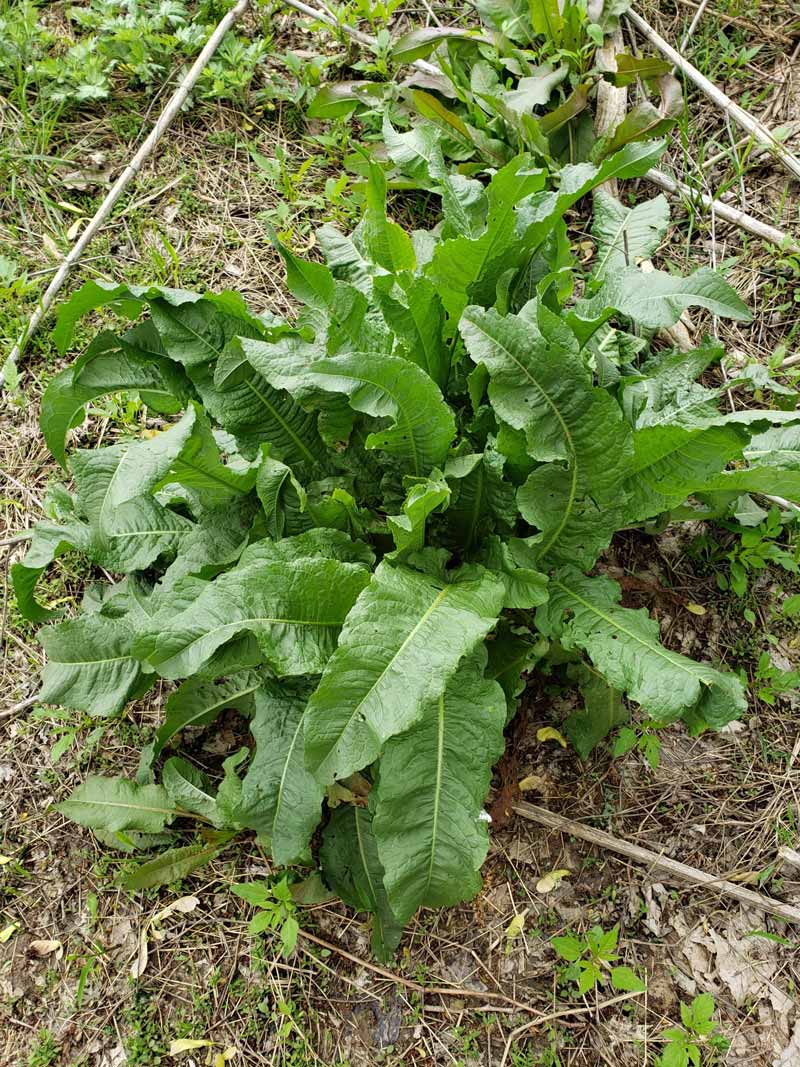
Curly dock. iNaturalist
The most common version of the dock family is curly dock (Rumex crispus). Sometimes known as “yellow dock,” this is a stocky, stalky upright that gets its name from its curled, elongated leaves.
Curly dock is most recognized by its rusty-looking flower stalks later in the season – stalks that can top out at three to five feet tall.
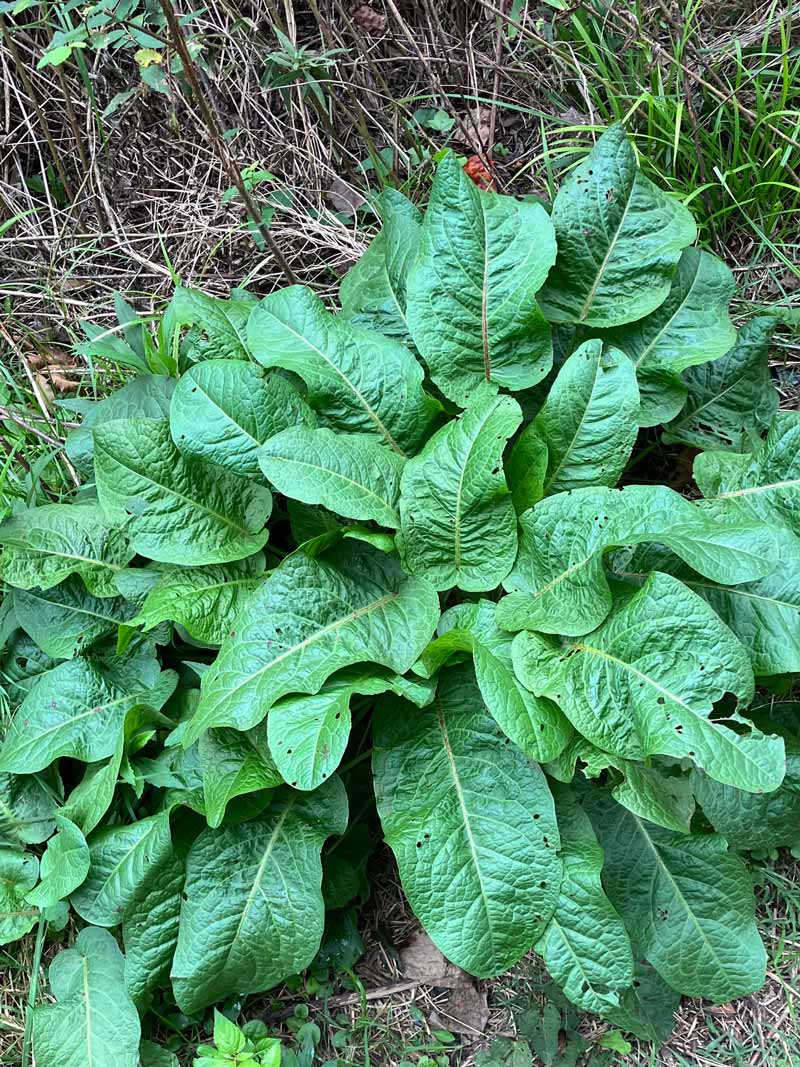
Broadleaf dock. iNaturalist
Broadleaf dock (Rumex obtusifolius) is a similar cousin (sometimes nicknamed “bitter dock”) that differs by sporting wider leaves that are less wavy. Its leaves also have heart-shaped lobes at the base.
Both of these common docks have deep taproots.
New docks sprout from soil-borne seeds in cool, damp soil, i.e. mid to late spring and early to mid-fall.
Plants start out as low rosettes of shiny, green leaves.
Curly dock clumps have narrow, wavy leaves that can range from six to 12 inches long but only two-and-a-half inches wide.
Broadleaf dock clumps are a bit denser and wider and have leaves of about 12 inches long and six inches wide.
Although broadleaf dock usually doesn’t flower in its first year, curly dock usually sends up flower stalks each year from year one.
Stalks start flowering in June with spikes of yellow-green, morphing into a reddish-brown or rusty color throughout summer.
The flowers mature into three-sided, winged structures that hold the seeds for next year.
Existing curly dock plants usually die to the ground over winter, while broadleaf dock often overwinters as a semi-dormant rosette of foliage.
In both cases, new foliage emerges and grows as the weather warms in spring.
Docks usually live for about four years or less and depend on new seeding each year to keep a colony thriving.
| Curly Dock | Broadleaf Dock | |
|---|---|---|
|
Common Name |
Curly Dock, Yellow Dock |
Broadleaf Dock, Bitter Dock |
|
Scientific Name |
Rumex crispus |
Rumex obtusifolius |
|
Life Cycle |
Cold-hardy perennial |
Cold-hardy perennial |
|
Growth Habit |
Upright stalks (3–5 ft), narrow; low rosettes |
Dense, broader rosettes; upright stalks |
|
Where it Grows |
Sunny wetlands, ditches, lawns, pastures |
Compacted beds, meadows, damp soil |
|
How it Spreads |
Prolific seeding (40k+ per plant) |
Seed and root regeneration |
|
When it Sprouts |
Mid-to-late spring & early fall |
Mid-to-late spring & early fall |
|
When it Flowers |
June through summer |
June through summer (rarely 1st yr) |
|
Root Type |
Deep, sturdy taproot |
Deep, sturdy taproot, more branched |
|
Best ID Features |
Clump of narrow, wavy "curled" leaves; flower stalks turn rusty brown as flowers mature |
Oval, less wavy foliage, flower stalks that turn brown as flowers mature |
Why people consider them weeds
The best method for removing existing dock weeds in the garden is digging, preferably when plants are young before roots have grown too deep. Dock weed tap roots can reach 3 to 4 feet with strong, branched side roots. Use a digging tool such as a garden fork or deep spade to loosen the soil around each plant’s root. Dig deeply to get as much of the tap root as possible before pulling, as any root fragments that are left behind will re-sprout, and pull gently. Weeding when the soil is wet after a rain helps.
Other mechanical methods
If hand-pulling isn't enough, herbicides can help control persistent dock weeds, especially those with large taproots.
Non-Selective Herbicides
Selective Lawn Weed Killers
If dock is growing in your lawn, choose a selective broadleaf weed killer that targets weeds without harming grass. Look for products containing active ingredients such as 2,4-D, MCPA, or dicamba. These are available in both liquid sprays and granular formulations.
Dock plants can be spot-sprayed with a variety of liquid herbicides formulated for use in lawns, including products such as 2,4-D, dicamba, MCPP, fluroxypyr, and triclopyr.
Widespread outbreaks of dock (and other broadleaf weeds) can be controlled with granular forms of broadleaf weedkillers formulated for lawns, such as GreenView Premium Formula Spring Weed & Feed and Crabgrass Preventer, which also fertilizes and prevents weed germination.
Tips for Best Results
Since docks are such prolific seeders, step one is making sure plants never grow to the point of flowering and setting mature seed. Continual mowing or cutting plants back can achieve that if you don’t get rid of the plants altogether. (A single curly plant is capable of producing 40,000 to 60,000 seeds per year.)
To discourage dock seeds from blowing in and colonizing a lawn, keep lawns as thick as possible through good cultural practices, including overseeding with quality grass seed, top-dressing the lawn with compost each fall, and testing the soil to ensure optimal fertilizer use.
Planting densely and/or using mulch is a similar defense against dock invasion in a landscape bed.
Granular weed preventers also are effective for keeping dock seeds from germinating in landscape beds.
Preen Extended Control Weed Preventer is labeled to control curly dock and can be applied in early spring around some 600 species of plants without harming them. (See the label for exceptions.)
In vegetable gardens, Preen Natural Vegetable Garden Weed Preventer is a granular product with corn gluten meal that’s labeled for curly dock prevention around existing vegetable plants.